

|
DR HAMID · HAMITA Hair Loss in Men The Complete Science-Based Guide Why half of Australian men lose hair by age 50 — and the evidence-based strategies to support healthy growth |
WRITTEN BY DR HAMID HOSSEINI
I'm a General Practitioner based in Glen Waverley, Victoria. For over a decade, I've seen the same pattern repeatedly in my clinic: men in their 30s and 40s with entirely correctable hair loss caused not by genetics, but by nutritional gaps their bodies couldn't fill on their own.
This guide is based on clinical evidence and 10+ years of helping Australian men address the root causes of hair thinning.
|
|

✓ General Practitioner
✓ Glen Waverley Medical Centre
✓ Australian Made Formulations
|
50% Men affected by 50 |
95% DHT sensitivity |
4–6 Months to results |
$000s Wasted yearly |
WHAT ACTUALLY CAUSES HAIR LOSS IN MEN?
Hair loss is rarely a single problem. It's the result of multiple biological systems failing simultaneously.

1 · DHT Sensitivity
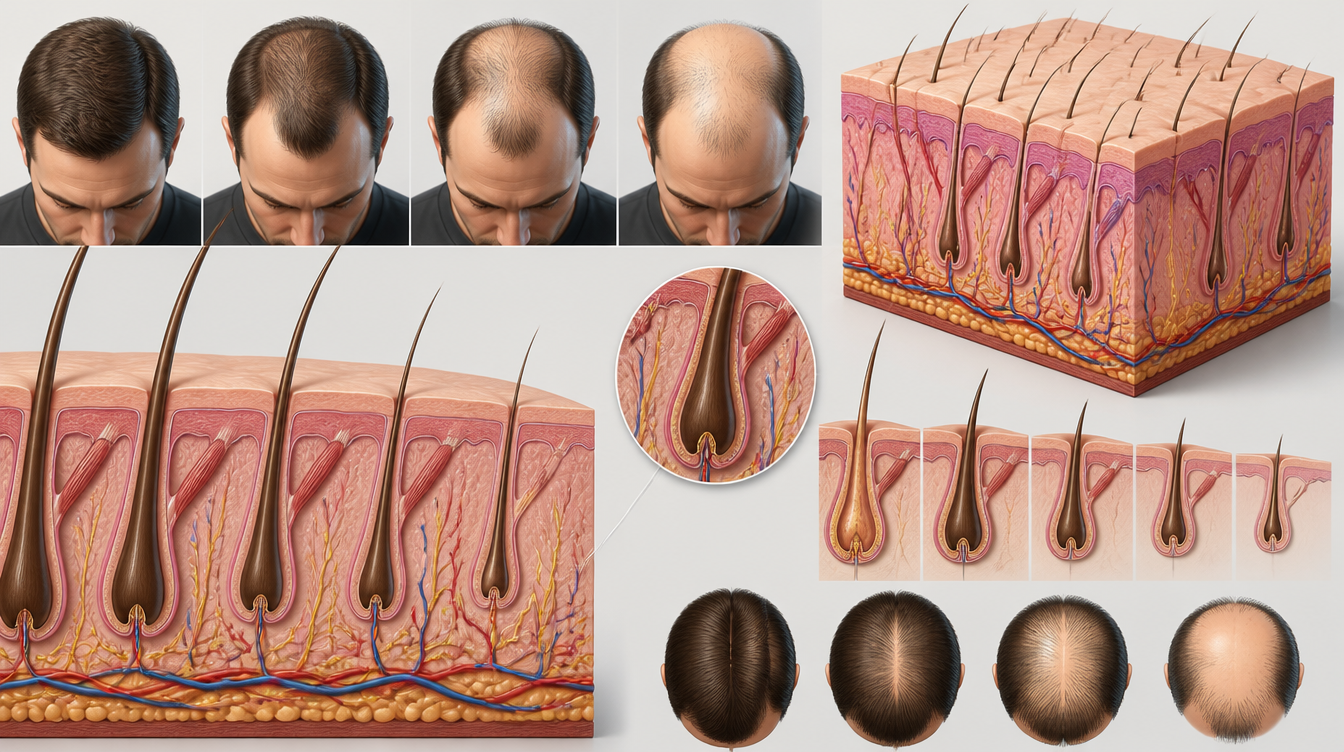
Dihydrotestosterone (DHT) is an androgen produced when the enzyme 5-alpha reductase converts testosterone. In genetically sensitive men, DHT causes follicles to miniaturise — producing progressively finer, shorter hairs.
But here's what most men don't realise: genetics loads the gun, but nutritional status pulls the trigger.
Many men with genetic predisposition to baldness never experience significant thinning because their nutritional status and lifestyle protect them.
2 · Nutritional Depletion
Hair follicles are metabolically expensive structures. They're among the most active cell populations in the human body and require a continuous supply of micronutrients to sustain the growth phase.
Most Australian men with hair loss have at least one measurable nutritional deficiency — zinc deficiency being the most common, followed by biotin and silica insufficiency.
3 · Oxidative Stress
Free radicals generated by UV exposure, pollution, physical exertion, poor diet, and psychological stress cause direct oxidative damage to follicle cells, shortening the growth phase.
Men who exercise regularly, work outdoors, or live in urban environments have significantly higher oxidative loads and greater potential benefit from targeted antioxidant support.
4 · Scalp Inflammation
Chronic low-grade scalp inflammation weakens the follicle anchor and accelerates shedding. Elevated DHT sensitises follicles to this inflammation, compounding the effect.
|
KEY INSIGHT While genetics determines your susceptibility to hair loss, three factors are directly modifiable: nutritional status, oxidative burden, and scalp inflammation. Most men focus exclusively on the one thing they can't control — while ignoring the three they can. |
THE HAIR GROWTH CYCLE
Hair doesn't grow continuously. It operates in four distinct phases, collectively lasting 2–7 years per cycle.

Anagen (Growth) — 2–7 years
The hair matrix actively divides, producing the hair fibre. Roughly 85% of your follicles are in anagen at any given time. When hair loss occurs, this phase progressively shortens — from years, to months, to weeks.
Catagen (Transition) — 1–2 weeks
The follicle transitions from growth to rest. The hair fibre detaches from the blood supply — brief but critical.
Telogen (Rest) — 2–4 months
Normally only 10–15% of follicles are in telogen. In hair loss, this elongates dramatically — 20–30% of follicles become dormant simultaneously.
Exogen (Shedding) — Varies
The hair falls out and the cycle restarts. Most men notice increased shedding here — but the problem began months earlier.
|
CRITICAL INSIGHT The “hair in the shower” men notice during exogen actually reflects problems that started 3–6 months earlier during the anagen-to-telogen transition. This is why early intervention matters so much. |
THE ESSENTIAL NUTRIENTS FOR HAIR HEALTH
Hair health depends on continuous supply of specific micronutrients. Most men are deficient in at least one.

|
Nutrient |
Biological Role |
Signs of Deficiency |
Optimal Dose |
|
Biotin (B7) |
Keratin synthesis — the structural protein making up 90% of hair shaft |
Hair fragility, splitting ends, weak nails |
2.5–5mg daily |
|
Zinc |
Regulates 5-alpha reductase; reduces DHT conversion |
Increased shedding, poor wound healing |
15–25mg daily |
|
Silica |
Strengthens hair shaft and follicle wall; supports collagen |
Hair brittleness, weak nails, poor skin elasticity |
10–40mg daily |
|
B Vitamins |
Support mitochondrial energy production that powers follicle cell division |
Fatigue, poor concentration, weak hair |
B-complex formulas |
|
Antioxidants |
Neutralise free radicals that damage follicle cells |
Premature ageing, poor wound healing |
Vitamin C 500–1000mg, E 15–30mg, Se 55–200mcg |
Why Supplementation Helps
Most Australian men don't get enough of these nutrients from food alone due to:
● Processed food diets low in micronutrient density
● Increased metabolic demand from exercise and stress
● Soil depletion reduces the nutrient content of produce
● Poor absorption due to age or digestive factors
Targeted supplementation closes these gaps without requiring a complete dietary overhaul.
WHY SHAMPOOS ALONE DON'T WORK
Topical products are limited by a fundamental biological constraint: they cannot address internal nutritional deficiencies.
|
Shampoos Cannot ✗ Correct zinc deficiency ✗ Replenish biotin ✗ Address DHT sensitivity ✗ Reduce systemic inflammation ✗ Provide systemic antioxidants |
Shampoos Can ✓ Support scalp health ✓ Remove buildup ✓ Reduce local inflammation ✓ Improve strength temporarily ✓ Prep scalp for serum |
Internal Nutrients Do ✓ Close nutritional gaps ✓ Modulate DHT naturally ✓ Extend anagen phase ✓ Reduce systemic inflammation ✓ Support hair from inside |
|
THE TAKEAWAY Most men need both topical and systemic support. Shampoos support existing follicles; supplementation addresses root causes. |
THE DR HAMID APPROACH
Over a decade of clinical observation revealed one thing: targeted nutrition changes the biology of hair loss.
I created Hamita Hair Growth Capsules to provide the clinical-grade formulation most men need — and most supplements don't offer.
|
|

How It Works
For DHT sensitivity, zinc and Saw Palmetto naturally modulate DHT without hormonal intervention.
For Nutritional Gaps — Biotin, Silica, and B vitamins provide the micronutrients most men are deficient in.
For Oxidative Stress — Australian botanical antioxidants protect follicles from UV and pollution damage.
|
CLINICAL FORMULATION Every ingredient was selected to address a specific biological pathway — the kind of targeted formulation that shampoos and generic supplements simply cannot provide. |
COMPLETE YOUR DAILY PROTOCOL
The Hair Growth Capsules are the nutritional foundation. These complementary products amplify results.
① Hair Growth Capsules Men — Foundation
Daily nutritional supplement targeting DHT, nutritional gaps, and systemic hair health.
|
|

② Hair Growth Shampoo 500ml — Step 1
Cleanses scalp without stripping oils. Removes buildup and preps for derma rolling.
|
|

③ Derma Roller 0.75mm — Step 2
Opens micro-channels in scalp for serum absorption. Use 3–5 times per week after shampooing.
|
|

④ Serum 100ml — Step 3
Apply within 60 seconds of derma rolling while micro-channels are open. Penetrates 40% deeper post-rolling.
|
|

⑤ Hair Regrowth Conditioner 500ml — Daily Care
Nourishes and strengthens hair, restoring moisture and reducing breakage.
|
|

⑥ — Complete System
Capsules, shampoo, conditioner, serum, and derma roller together.
|
|

WHAT TO EXPECT: THE TIMELINE
Hair operates on a 90-day growth cycle. Results compound with consistency.
Weeks 2–4 · The Earliest Signs
Most men notice improved skin quality and firmness — the earliest signal the formula is working systemically.
Weeks 4–8 · Shedding Stabilises
Hair lost in the shower reduces noticeably. Nails harden — a reliable early indicator of systemic biotin and silica response.
Months 2–4 · Density and Thickness Improve
Existing hair becomes visibly thicker. New growth appears at the hairline and crown.
Months 4–6 · The Compounding Effect
Re-nourished follicles continue producing progressively stronger, thicker hair with each cycle.
|
IMPORTANT Consistency is the single most important variable. One capsule, every morning, with breakfast. The biology follows. |
FREQUENTLY ASKED QUESTIONS
Q. Can men naturally regrow lost hair without medication?
Yes — but “regrow” and “stop shedding” are different processes. Most men can stop progressive shedding through nutritional optimisation and lifestyle changes.
True regrowth of hair that's been permanently lost usually requires targeted supplementation or pharmaceutical intervention, depending on how long the follicle has been dormant.
Q. How much zinc do I need for hair growth?
The optimal range is 15–25mg daily. Excess zinc (over 40mg) can interfere with copper absorption and actually impair hair health.
Q. Is DHT the only cause of male hair loss?
No. DHT sensitivity accounts for roughly 95% of male pattern baldness, but nutritional deficiency, oxidative stress, and inflammation are necessary co-factors.
Q. Can vitamins actually stop hair shedding?
Yes, with caveats — vitamins cannot regrow permanently lost hair, but they can extend the anagen phase and support existing hair strength.
In men with nutritional deficiencies, supplementation can stop progressive shedding within 4–8 weeks.
Q. What's the difference between hair loss and normal shedding?
Normal shedding is 50–100 hairs daily. Hair loss occurs when more follicles enter the rest phase simultaneously — over 100–150 hairs daily suggests accelerated telogen transition.
Q. Should I use minoxidil or finasteride alongside supplements?
These are complementary, not competitive. Nutritional supplementation addresses deficiencies and inflammation alongside pharmaceutical options — consult your GP before starting any medication.
Q. How long until I see results?
Skin quality typically improves within 2–4 weeks. Shedding reduction within 4–8 weeks. Visible thickness within 2–4 months. True regrowth can take 4–6 months.
Q. Can women use these capsules?
The formula is specifically designed for male hair loss pathways. Women should consult a healthcare provider before use.
Q. What if I have a medical condition or take medications?
Biotin, zinc, silica, and B vitamins are safe in supplemental doses for most people — but consult your GP if you have kidney disease, take blood thinners, or have other conditions.
WHAT MEN ARE SAYING
|
“I've been using the capsules for 4 months now. My hair thickness has genuinely improved, and my skin looks better too. This actually works.” James · Melbourne, VIC |
|
|
|
“Within 6 weeks my shower drain was clear again. I was sceptical but the science behind this made sense.” Marcus · Sydney, NSW |
|
|
|
“The timeline they provided was accurate. I noticed skin changes first, then shedding reduced, then visible thickness. It's a process, not overnight.” David · Brisbane, QLD |
|
|
THE EVIDENCE POINTS IN ONE DIRECTION
Most male hair loss is not purely genetic. It's the result of modifiable biological factors — nutritional deficiency, oxidative stress, and inflammation — that amplify genetic predisposition.
Shampoos and serums can support existing follicles, but they cannot address these root causes. The men seeing the best results aren't chasing hype — they're addressing the biology.
Start with the fundamentals: adequate zinc, biotin, silica, antioxidants, and lifestyle support for scalp health.
All information is educational and does not constitute medical advice. Consult your GP for personalised health guidance.


Leave a comment
This site is protected by hCaptcha and the hCaptcha Privacy Policy and Terms of Service apply.